EU Kids Act explained: No social media under 13, own account at 15. What parents need to know
No account under 13, parent-managed mini accounts at 13 and 14, independent accounts from 15: what the proposed EU Kids Act would change, and why it isn't law yet.
Last updated: 8 October 2026. The EU Kids Act is a legislative proposal from the European Commission, not law yet. I'll update this post as it moves forward.
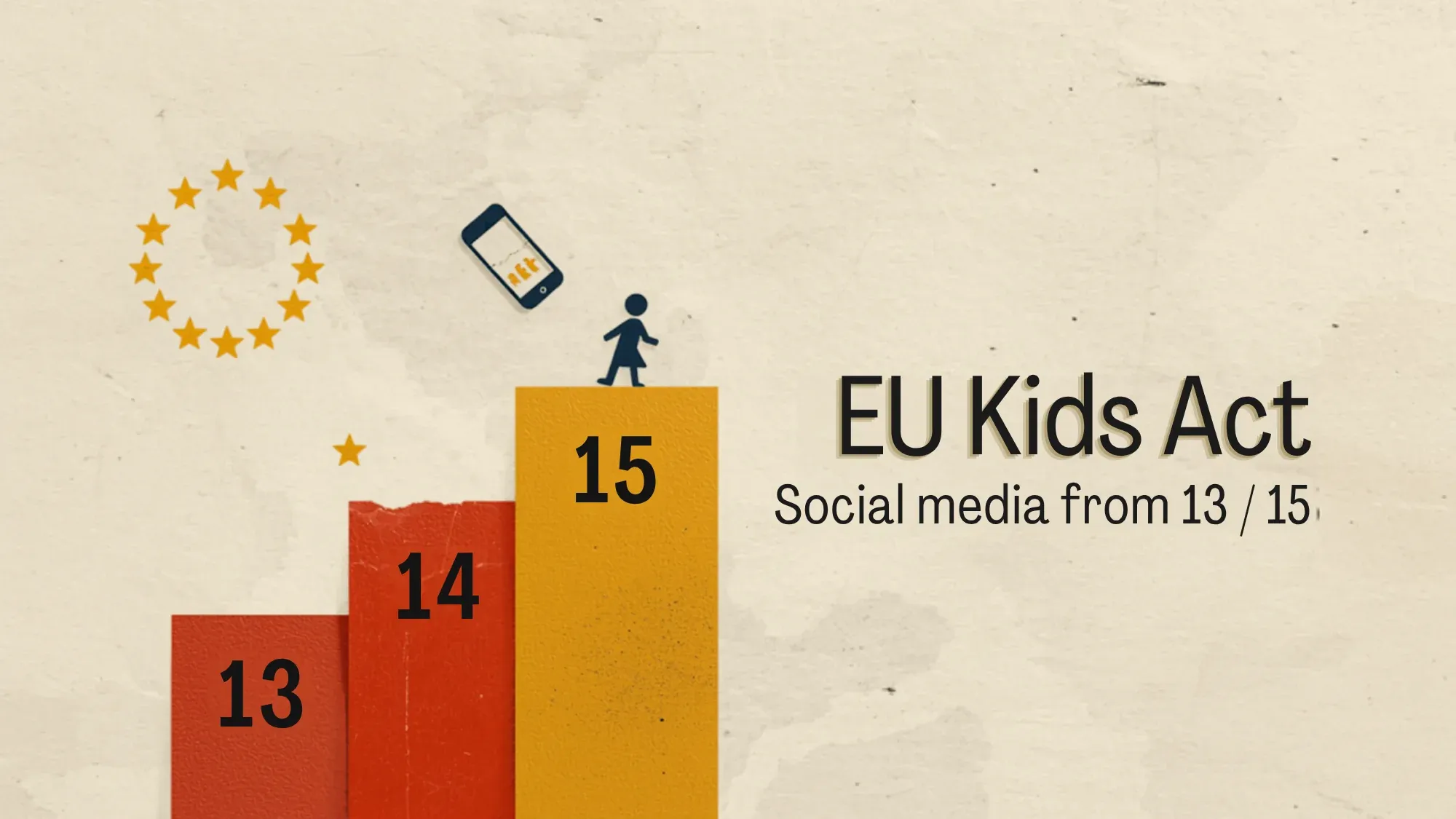
The short answer: Under the proposed EU Kids Act, children under 13 couldn't have a social media account at all. At 13 and 14, only a parent-managed "mini account" with a one-hour daily cap would be allowed, and teens could open their own account at 15. But it's only a proposal, published on 17 September 2026, and nothing applies yet.
Key takeaways
- Under 13: no social media account.
- 13 and 14: a limited account set up and controlled by a parent: max. one hour a day, new contacts only with parental approval.
- 15+: their own account, on services that must be safe for teens by design.
- No more fake birthdays: age must be checked by certified tools, without the platform seeing your ID.
- Status: proposal. The European Parliament and EU member states still have to agree.
What is the EU Kids Act?
On 17 September 2026, the European Commission proposed a new regulation to protect children online. The full name is a mouthful ("EU Keeping Internet Digital Spaces Accountable and Trustworthy"), so everyone just calls it the KIDS Act (European Commission press release, 17 Sept 2026).
Commission President Ursula von der Leyen put the core idea in one line: "Our KIDS Act is reversing the burden of proof: it is for platforms to show they are safe by design." Until now, parents and regulators had to prove that something was harmful. Under the proposal, TikTok, Instagram and the rest would have to prove their services are safe for children.
If you only remember one thing: this is not just a "social media ban". The Commission itself calls the age limits merely "the most visible part". Most of the proposal is about how apps must be designed (European Commission: The KIDS Act explained, accessed 8 Oct 2026).
What age limits does the proposal set?
The Commission describes it as "a staircase that follows how children grow up". The age rules apply to social networks and video-sharing services with demonstrably risky features (European Commission FAQ):
- Under 13: no account. One narrow exception: on video platforms built specifically for young children, a parent can allow limited access through the parent's own account, with no personalised feed, no search, and a daily limit of up to one hour.
- 13 and 14: a parent can set up a limited account. Parental tools are always on, there's a daily cap of one hour, and new contacts need parental consent.
- 15 and over: teens can open their own account on services that are legally required to be safe for them.
What about the account your 14-year-old already has? Within six months of the rules applying, platforms would have to check whether existing account holders are under 15, and block accounts of younger users or users whose age can't be established.
How would age checks work? Will my child need to upload a passport?
No. And I want to be clear about this, because there's a lot of confusion around it. Today, a date-of-birth box is the only barrier, and every 11-year-old knows how to type "2005". The proposal says explicitly that self-declared age is no longer enough.
Instead, age would be checked by certified tools that work independently of the platforms, such as a free EU age-verification app and, later, the EU digital identity wallet. The platform only learns one thing: above or below the age limit, yes or no. It doesn't learn who you are. Every member state would have to offer at least one free option, including for people without a digital ID (European Commission FAQ).
Australia shows why this matters. Its under-16 social media minimum age took effect on 10 December 2025. Three months later, fewer children held accounts: 42.1% of 10- to 15-year-olds, down from 52.4%. But among those who still had one, 50.2% said the platform had simply never asked them to confirm their age (eSafety Commissioner evaluation, August 2026). A law is only as good as its enforcement.
What would change inside the apps?
This is the part I find most interesting, because it affects teens over 15, too. For minors, the proposal would ban, among other things (European Commission FAQ):
- endless autoplay and infinite scroll without real breaks,
- notifications designed purely to pull a child back into the app,
- "streaks" that punish kids for skipping a day,
- contact from strangers without prior approval, and livestreaming would be off by default.
Feeds for children would have to be optimised for safety and mental health rather than engagement, and tracking-based personalisation would be off by default.
One detail many people miss: AI chatbots and "AI companions" are covered too. They must not use designs that simulate human relationships in ways likely to create emotional dependency, and under-13s could only use them through parental-control tools. Why that matters so much is the topic of my next post, "My child tells the AI more than me".
Breaking the rules would be expensive: fines of up to 6% of global annual turnover. The biggest platforms (45 million+ monthly users in the EU) would have to submit a compliance plan checked by independent auditors, at their own cost (European Commission FAQ).
Is it law yet? And what happens next?
No. The KIDS Act is a "proposal for a regulation". The European Parliament and the member states still have to negotiate and adopt it, and the details may change along the way (Rhineland-Palatinate Representation to the EU, in German). There's no start date yet. A public consultation is open until 26 November 2026, and parents can submit feedback too (European Commission: call for feedback, 2 Oct 2026).
Several countries had been pushing their own rules. In Germany, a government-appointed expert commission recommended on 24 June 2026, as one option, a statutory minimum age of 13 (European Audiovisual Observatory summary). But the German Bundestag's research service sees very little room for national bans, because EU law takes precedence (netzpolitik.org, in German). That's why the EU level is where this will really be decided.
My take: well-intended, but no substitute for parenting
A lot of this proposal is right, above all, that it finally puts responsibility on the platforms instead of only on parents. But no law will explain to your child why a video has been manipulated, or why a stranger in a chat is being suspiciously nice. That's media literacy, and there's no app for it. The kitchen table is still where it happens.
What parents can do today
- Don't wait for Brussels. Instagram, TikTok and Snapchat already require users to be at least 13 in their terms of service. Take that seriously.
- Set up safety settings together: screen time, private profiles, contact requests from friends only.
- Turn off autoplay. What the EU wants to ban, you can often switch off yourself today.
- Talk, don't just block. Ask what your child enjoys watching, and why.
- Have your say: if you live in the EU, you can take part in the Commission's consultation until 26 November 2026.
FAQ: the EU Kids Act
Is the EU Kids Act in force?
No. As of 8 October 2026, the EU Kids Act is a European Commission proposal published on 17 September 2026. The European Parliament and member states still need to adopt it, details may change, and there is no start date yet.
At what age could children use social media under the proposal?
No account under 13; at 13 and 14, only a parent-managed account with parental controls and a one-hour daily cap; from 15, their own account on services that are safe by design.
Will my child have to upload an ID?
No. Age would be verified by certified tools independent of the platforms, such as an EU app. The platform only learns whether someone is above or below the age limit. It doesn't learn who they are.
What happens to existing accounts of under-15s?
Under the proposal, platforms would have six months after the rules apply to check existing accounts and block those belonging to under-15s or to users whose age can't be established.
Does the Kids Act cover AI chatbots?
Yes. AI chatbots and companions accessible to minors could not use designs that foster emotional dependency, and under-13s could only use them via parental-control tools.
AI supported me in researching and drafting this post. I have reviewed the text myself and I am editorially responsible for it. Marek Schilke
About the author: Marek Schilke has been active in child and youth work for two decades and has worked as a qualified educator (Erzieher) since 2015. As a media educator, he translates digital topics into plain language for families, with no legal or tech jargon. Through his project AI Buddy he works on digital sovereignty for families. Eight years as a co-operative board member, four co-operatives of his own and more than 100 start-ups supported have taught him one thing: rules only work when everyone understands them.
This post is a plain-language explainer, not legal advice.
👉 Want to know when the Kids Act is adopted? Subscribe to my free newsletter.